Thesis: The Civil War consisted of the antislavery North versus the newly seceded South. They engaged in various battles led by genius generals and an unbelievable amount of casualties. Thus begins the bloodiest war in American History.
Fort Sumter
Fort Sumter
On April 12th, 1861, General Beauregard and the Confederate authorities attacked the Union base of Fort Sumter in Charleston Harbor. Lincoln did not want to engage in violence and was just sending supplies to the Union men in the Fort. The South saw this as an act of war and attacked the fort until the next day when Major Robert Anderson surrendered. No one was killed in this battle It was a Confederate victory that humiliated the Union. http://news.nationalgeographic.com/news/2011/04/110412-fort-sumter-civil-war-nation-150th-anniversary-first-battle/ This website provides a description of why the civil war was inevitable from this battle onward.
 |
| The Confederates attack Fort Sumter |
First Battle of Bull Run
On July 21, 1861, the Union expected this to be a quick war, so General Winfield Scott ordered General Irvin McDowell and many untrained Union troops to attack Bull Run Creek. McDowell and his men looked to win, until the South received reinforcements from Shenandoah Valley. General Thomas J. Jackson, nicknamed "Stonewall", of the Confederate army held his ground against the Union and forced them to retreat in the direction of Washington D.C. This battle proved that the war was going to be very long. http://www.eyewitnesstohistory.com/bullrun.htm This website provides a letter that a soldier in the battle wrote.
 |
| Stonewall Jackson overseeing the Battle of Bull Run |
Shiloh
This battle began in April 16th, 1862 and ended on April 17th. General Ulysses S. Grant led his Union army into the Tennessee River. The Confederates launched a surprise attack led by General Johnson and Beauregard on the first day in order to defeat the Union before reinforcements arrived. The Confederates pushed hard and pushed the Union soldiers into Hornet's nest. The Union had time to stabilize in here. General Johnson died on day one, and Beauregard decided not to attack during that night. On the second day, reinforcements arrived from the Huell's army and more from Grant's own. They pushed the Confederates out until they retreated from the bloodiest battle so far.http://www.nps.gov/hps/abpp/battles/tn003.htm This provides a detailed summary of the battle.
This battle began in April 16th, 1862 and ended on April 17th. General Ulysses S. Grant led his Union army into the Tennessee River. The Confederates launched a surprise attack led by General Johnson and Beauregard on the first day in order to defeat the Union before reinforcements arrived. The Confederates pushed hard and pushed the Union soldiers into Hornet's nest. The Union had time to stabilize in here. General Johnson died on day one, and Beauregard decided not to attack during that night. On the second day, reinforcements arrived from the Huell's army and more from Grant's own. They pushed the Confederates out until they retreated from the bloodiest battle so far.http://www.nps.gov/hps/abpp/battles/tn003.htm This provides a detailed summary of the battle.
 |
| Map of the Battle of Shiloh |
Merrimack vs. Monitor
 |
| The Battle of Hampton Roads |
http://www.history.navy.mil/photos/sh-usn/usnsh-m/merimak2.htm This website describes the Merrimack.
Antietam
This battle on September 17, 1862, was the first battle on Union soil and the bloodiest battle in American History with 22,717 people dead, wounded, or missing. General Robert E. Lee of the Confederacy was being pursued by Union General McClellan into Maryland. McClellan launched an attack on Lee's army behind Antietam creek. General Joseph Hooker joined the fight and managed to get a good attack on Lee's left flank. Shortly after, General Burnside attacked the right side until Confederate General Hill managed to arrive form Harper's Ferry and drove Burnside and his men back, ending the battle. McClellan had many more men, but failed to attack ferociously enough to officially defeat them. However, the Union stopped Lee's invasion of Maryland and caused the Confederacy to fall back, technically giving the Union another victory. http://www.americaslibrary.gov/jb/civil/jb_civil_battle_1.html
 |
| The Union pushing the Confederate army back in Antietam |
Chancellorsville
This battle was fought on April 30th, 1863 to May 6th. It began when the federal infantry, located
near Chancellorsville and Hooker's army in Fredericksburg attacked Lee's army from the front and rear. Lee split his army and had 4/5th's of it to fight Hooker's men and used the other faction to hold off Fredericksburg. Hooker was very timid and despite objections from others, he went on the defensive, giving Lee the upper hand. On May 3rd, the bloodiest part of the battle occurred when Lee launched an all-out assault on Chancellorsville. At the same time, General Sedgwick and his men took out the small faction of Confederate men at Fredericksburg, but he was eventually surrounded, and had to withdraw. Hooker's men also withdrew. The South gained a victory. http://www.nps.gov/frsp/chist.htm
This battle was fought on April 30th, 1863 to May 6th. It began when the federal infantry, located
near Chancellorsville and Hooker's army in Fredericksburg attacked Lee's army from the front and rear. Lee split his army and had 4/5th's of it to fight Hooker's men and used the other faction to hold off Fredericksburg. Hooker was very timid and despite objections from others, he went on the defensive, giving Lee the upper hand. On May 3rd, the bloodiest part of the battle occurred when Lee launched an all-out assault on Chancellorsville. At the same time, General Sedgwick and his men took out the small faction of Confederate men at Fredericksburg, but he was eventually surrounded, and had to withdraw. Hooker's men also withdrew. The South gained a victory. http://www.nps.gov/frsp/chist.htm
 |
| General Robert E. Lee |
Vicksburg
The final major military assault of the war on Vicksburg, on May 18, 1863 to July 4, General Grant led the army of Tennessee past the Mississippi River and drove the Confederate army led by General Pemberton into defensive lines in Vicksburg. The Confederates were trapped there with limited supplies, so Grant ordered a siege on Vicksburg. The Confederates held out for forty days before finally surrendering. The Union now controlled the Mississippi River. This battle along with the Battle of Gettysburg are considered the turning point of the war. http://www.civilwar.org/battlefields/vicksburg/maps/vicksburgmap.html Includes map
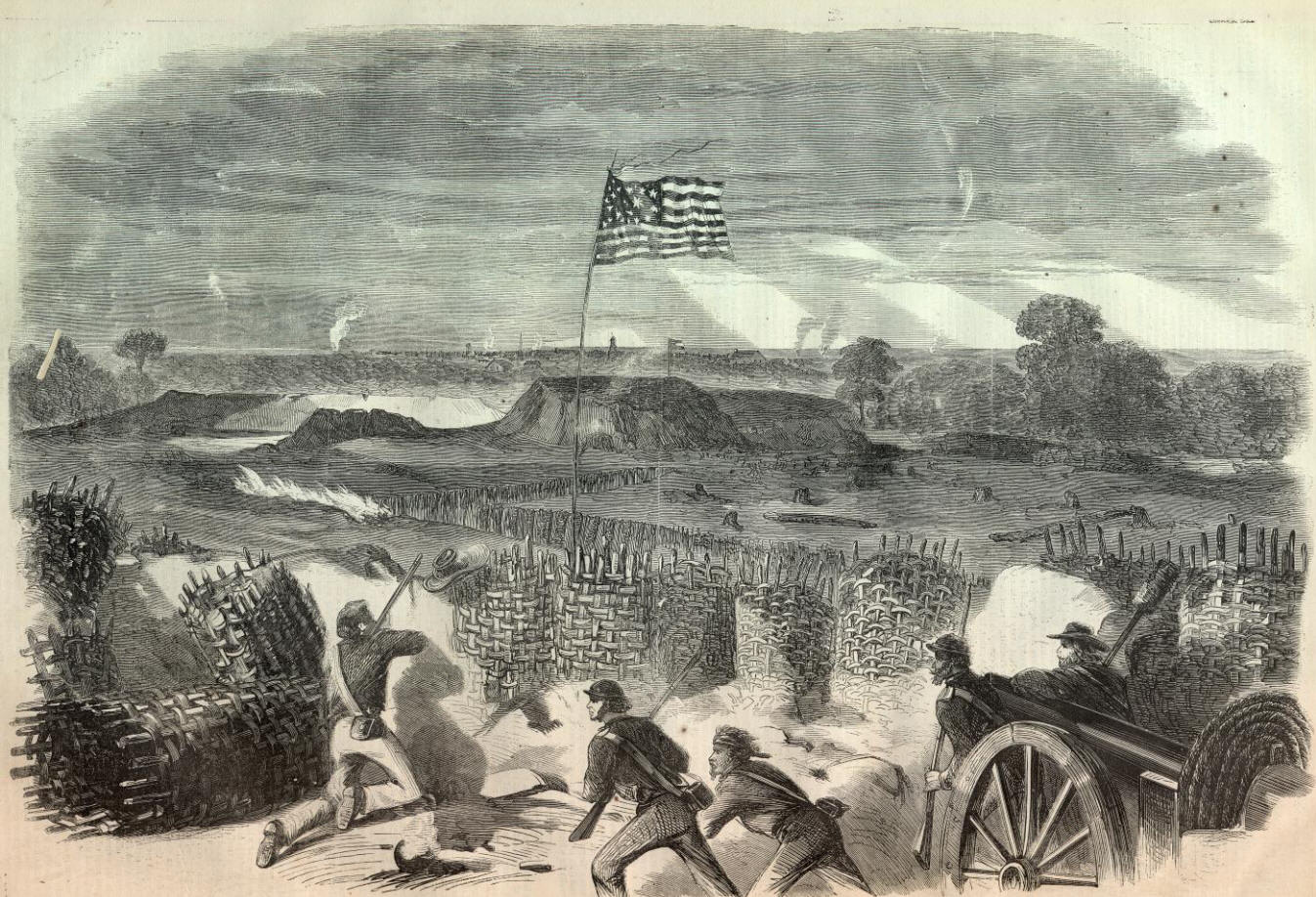 |
| The siege of Vicksburg |
Gettysburg
This battle took place on July 1st to July 3rd, 1863. After his great victory at Chancellorsville, General Robert E. Lee wanted to attack the North at Gettysburg, Pennsylvania. General Hooker was meant to defend, but Lincoln replaced him with General Meade. He stood between the Confederates and Washington D.C. On the first day, the Confederates succeeded in driving the Union back from towns north and west of Gettysburg. On the second day, Union soldiers defended a series of hills with 90,000 men. The Confederates attacked with 70,000. They made a lot of progress, but the Union still held the hills. On the final day, The fighting returned to Culp's hill as many Confederate soldiers attacked. They were fired at by heavy artillery from the Union and had to retreat to Virginia. This is considered the turning point in the war as well as the bloodiest battle. Lincoln gave his Gettysburg address 4 months later. http://www.historyplace.com/civilwar/battle.htm
 |
| The Battle of Gettysburg, the turning point |
Sherman’s March
This was the march that General William Tecumseh Sherman made with his troops from Atlanta, Georgia on November 15th to Savannah on December 21, 1864. In order to win the war, Sherman and Grant decided that they needed to completely break the South and the way it functioned. On this march, Sherman and his men burned and destroyed military, industrial, and economical benefits of the South. They tore down villages as well. This is considered to be total war. http://www.history.com/topics/william-t-sherman William Sherman Biography
 |
| Sherman's March with his burning of towns |
Appomattox Courthouse
This was one of the final battles of the war, as well as the one that ended it. On April 9th, 1865, General Robert E. Lee left Virginia with his army and hoped to regroup with the other Confederate armies in North Carolina. However, the Union army led by Ulysses S. Grant cut off the Confederates at Appomattox Courthouse. Lee wanted to charge ahead assuming that the Union army just had cavalry. However, after seeing that they were reinforced by two groups of infantry, Lee surrendered. http://www.civilwar.org/battlefields/appomattox-courthouse.html
This was one of the final battles of the war, as well as the one that ended it. On April 9th, 1865, General Robert E. Lee left Virginia with his army and hoped to regroup with the other Confederate armies in North Carolina. However, the Union army led by Ulysses S. Grant cut off the Confederates at Appomattox Courthouse. Lee wanted to charge ahead assuming that the Union army just had cavalry. However, after seeing that they were reinforced by two groups of infantry, Lee surrendered. http://www.civilwar.org/battlefields/appomattox-courthouse.html
 |
| General Lee's surrender |
Civil War Medicine
Because of the new developments in better rifles, the amount of casualties reached an insane high. In order to cope with this, methods of treatment developed. Throughout the war, on both sides, systems of ambulance were developed and hospitals were made in areas of combat. The most typical kind of treatment to do was amputation. Wounds in areas besides the limbs usually resulted in death. To give the soldiers less pain for the procedure, mass amounts of chloroform were used to knock the patient unconscious. Because of the many wounded soldiers, as well as not having much knowledge about the topic, diseases caused many deaths. The enormous amount of soldiers gave the doctor no time to wash his/her hands, spreading germs and diseases all over. Some thought that the pus produced from injuries meant healing, but it was infection. http://www.sonofthesouth.net/leefoundation/civil-war-medicine.htm This website provides a detailed explanation about how amputation during the civil war worked as well as documents from the Civil War explaining it.
 |
| Amputation from the Civil War |
Battle Technology/Tactics
Technology: Before this war, soldiers fought with muskets that were very inaccurate and required very close range to be effective. However, new rifles were designed that fired minié balls which were much more effective and deadly. A new innovation was created in the North where more than one shot could be fired before needing to reload as well. In the North, Balloons powered by helium were used to spy on the Confederates from the air. They also possessed iron-clad war ships used to blockade the South. To combat this, the South made submarines. The railroad an innovation that provided an easy and fast way for the north to travel and distribute supplies. The telegraph was another northern weapon used by Lincoln to communicate with the battlefield. Information was distributed quickly. Photography was developed at the time, making the Civil War the first war with pictures to document it. This changed the lives of the citizens as they got to experience the war in a different way.
Tactics: The old-style way of warfare was used for the majority of the battles in the Civil War. Two armies would clash as one sat in a trench while the other attempted to come close and kill them. This proved to be very ineffective for the attacking side because the new rifles killed from a long distance away. Other battle tactics made were to divide the army to fend off multiple threats by Robert E. Lee, the anaconda plan designed by Winfield Scott in order to close off the South from the outside, and various battle strategies made by the North and South. To go into further detail on the battle tactics of the Civil War this website http://www.civilwarhome.com/strategyandtactics.htm will provide great information.
 |
| The minie-ball |
Tactics: The old-style way of warfare was used for the majority of the battles in the Civil War. Two armies would clash as one sat in a trench while the other attempted to come close and kill them. This proved to be very ineffective for the attacking side because the new rifles killed from a long distance away. Other battle tactics made were to divide the army to fend off multiple threats by Robert E. Lee, the anaconda plan designed by Winfield Scott in order to close off the South from the outside, and various battle strategies made by the North and South. To go into further detail on the battle tactics of the Civil War this website http://www.civilwarhome.com/strategyandtactics.htm will provide great information.
Life as a Soldier
When not facing combat in battle, life as a soldier was spent with either training or free time. Constant drilling sessions would occur in order to produce great armies. Outside of this, soldiers would get bored very easily. They could write to home and rest, but most of the time, soldiers played many games and gambled in chess, dominoes, checkers, and cards. The war was very long and being away from home for an extended amount of time leads to games that allow time to pass faster. http://www.civilwar.com/overview/soldier-life.html
This video is made by Crash Course, a Youtube channel all about education. This video serves to show all the various battles of the Civil War in a very easy to follow and fun way. John Green is the narrator behind it and he is very good at providing some forms of humor in his descriptions.
 |
| Northern Soldiers |

No comments:
Post a Comment